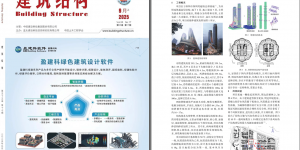
[论文][Paper] 深圳某400m双塔连体结构TLD风振控制可行性研究 (Feasibility investigation of wind-induced vibration control using TLD for a 400-meter twin-tower connected structure in Shenzhen)

The structural system of a 400m twin-tower linked project in Shenzhen features a frame-core tube configuration with outriggers and belt truss strengthening story, comprising eastern and western towers connected by connective structure. Due to complex architectural geometry, high wind loads, and unique site-specific wind conditions, under 10-year return period wind loads from the southeastern direction, the towers exhibit significant dynamic responses. Wind-induced accelerations at the tower tops substantially exceed code limits, resulting in occupant comfort deficiencies. To address this, tuned liquid dampers (TLDs) were proposed for wind vibration control. Spectrum analysis was employed to identify governing vibration modes of structural wind-induced responses. Time-history analysis was conducted to evaluate wind-induced dynamic responses of the TLDs-equipped structure, with parametric sensitivity analysis subsequently optimizing TLD design parameters. The results demonstrate that the structural base shear and the wind-induced acceleration spectrum at the eastern tower top exhibit a single-peak characteristic, primarily governed by the first translational mode of the eastern tower. The wind-induced acceleration spectrum at the top of the western tower shows a double-peak characteristic, influenced concurrently by the first translational modes of both the eastern and western towers. TLDs installed atop the eastern tower significantly reduce base shear and wind-induced accelerations at both tower tops. However, TLDs at the top of the western tower only effectively mitigate accelerations perpendicular to the connective structure but show no significant control effect on accelerations along the connective structure direction, the accelerations at the top of the eastern tower, or the structural base shear. Furthermore, when TLDs are installed simultaneously at the tops of both towers, wind-induced accelerations are effectively controlled, ensuring compliance with code-specified limits.
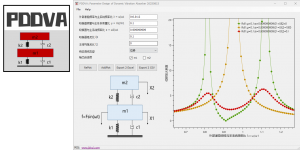
[程序] PDDVA: Parameter design of dynamic vibration absorber [PDDVA: 动力吸振器参数设计软件]

实干、实践、积累、思考、创新! 程序图标 ( Program Icon ) 程序介绍 ( Program Introduction) 这是一款在学习振动控制过程中开发的动力吸振器参数分析工具。目前主要集成了经典的二自由度系统模型(即调谐质量阻尼器TMD模型)。用户可通过该程序调整多种参数,生成频响曲线图,并将结果导出至Excel,从而辅助经典振动理论的学习与研究。未来计划扩展更多类型的吸振器模型,并逐步加入参数敏感性分析等功能。 This parameter analysis tool for dynamic vibration absorbers was initially created as a side project during vibration control studies. It currently …

[振动控制] 常见质量阻尼器分类 [Passive, semi-active, active and hybrid mass dampers]

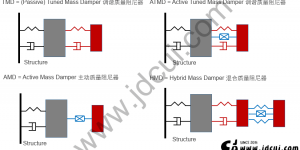
实干、实践、积累、思考、创新。 最近查看一些调谐质量阻尼器的资料,发现很容易混淆各类质量阻尼器,而且不同资料在描述一些阻尼器时名字虽然一样,但是可能说的不完全是一个东西。 于是趁着这个机会,梳理一下各类质量阻尼器的一些基本概念。 常见的一些阻尼器包括: TMD = (Passive) Tuned Mass Damper (被动)调谐质量阻尼器 ATMD = Active Tuned Mass Damper 主动调谐质量阻尼器 AMD = Active Mass Damper 主动质量阻尼器 HMD = Hybrid Mass Damper 混合质量阻尼器 …

[日记][图] “济济一谈”沙龙 12期 | 基于调谐液体阻尼器(TLD)的高层建筑风振控制分析与工程应用

实干、实践、积累、思考、创新。 2023年5月29日,“济济一谈”沙龙 2023年第12期活动在 RBS 广州总部举行。这次我分享的题目是《基于调谐液体阻尼器(TLD)的高层建筑风振控制分析与工程应用》,介绍了高层建筑结构风振控制概况、常用风振控制措施、调谐液体阻尼器(TLD)的减振原理、TLD阻尼器抗风减振设计流程、某450m超高层塔楼TLD抗风减振分析、某400m双塔连体结构TLD抗风减振分析。这次“济济一谈”沙龙采取了线下对外开放的方式,部分其他单位的朋友也来参加了讨论,非常感谢。这里做个记录。 济济一谈是RBS内部的技术学习交流专享会,2023年正值事务所20周年纪念,秉承分享的初心,我们首次开通线上报名,鼓励大家到场参与学习和交流,因部分课程内容涉及较多自身研究,带一定的探索特性,可能存在较多一家之言的地方,需更严谨的探讨。后续还有其他课程和继续分享,请持续关注本群发布动态,再次感谢大家的支持。 相关信息 [01] [日记][图] “济济一谈”沙龙 08期 | ENGT超限结构辅助设计集成系统-研发与应用 [02] [预告][济济一谈] 基于调谐液体阻尼器(TLD)的高层建筑风振控制分析与工程应用 微信公众号 ( Wechat Subscription) 欢迎关注 “结构之旅” 微信公众号

[预告][济济一谈] 基于调谐液体阻尼器(TLD)的高层建筑风振控制分析与工程应用

实干、实践、积累、思考、创新。 内部讲座预告,欢迎广州地区的朋友线下参加! 济济一谈” 是RBS内部相当活跃的技术交流平台,在实际工程中遇到的各类问题和解决方案,同事们都可以开放地交流,相互启迪。 微信公众号 ( Wechat Subscription) 欢迎关注 “结构之旅” 微信公众号

[转载] 2023筑信达用户大会2号通知-入围名单揭晓

实干、实践、积累、思考、创新。 参加 2023筑信达用户大会,入围了两个项目: (1)调谐液体阻尼器(TLD) 抗风减振分析与工程应用 (2)ERDP减震辅助设计软件开发与应用 这里转载记录一下,以下内容转载自 筑信达 公众号。 微信公众号 ( Wechat Subscription) 欢迎关注 “结构之旅” 微信公众号

[笔记][算例][减振] TLD调谐液体阻尼器减振算例 [Example of Vibration Reduction of Tuned Liquid Damper (TLD) ]

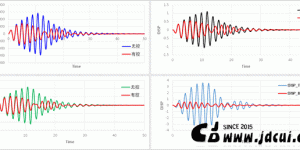
实干、实践、积累、思考、创新。 最近项目用到水箱进行风振控制,于是研究一下水箱减振的相关理论及工程计算分析。 这里的水箱其实说的是调谐液体阻尼器(Tuned Sloshing Damper,TSD)这类东西又称为TLD (Tuned Liquid Damper )。 TSD 是利用晃动的液体吸收并耗散结构振动能量的附加阻尼系统。TSD 实质上是箱体,部分以液体(一般为水)填充并置于结构顶部。通过选择合适的 TSD 箱体尺寸和液体深度,可以将晃动的频率“调谐”至结构的自振频率。由于结构的共振响应,TSD 箱体内的液体将开始晃动,从而振动能量通过结构传递给 TSD,该能量进而由箱体的阻尼装置耗散。 以下来个个简单算例测算。 无控模型 模型为一个5X5跨的19层的框架结构算例,如下图。 结构的振型信息 第1级第2阶平动振型,周期为1.96s。 结构总的质量为 9079960kg,即9079.96吨。 施加一个测试用的正弦加速度时程,其中加速度时程的周期选为结构的周期,以使结构的动力响应最大。 无控结构时程分析结果 基底剪力,顶点加速度,顶点位移 TLD参数计算 设置振荡目标质量比为2%,通过自编的 TLDPC 软件( [结构][软件] …

[结构][软件] TLDPC: 调谐液体阻尼器参数计算器 [TLDPC: Tuned Liquid Damper (TLD) Parameter Calculator]

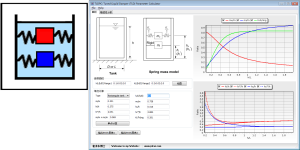
实干、实践、积累、思考、创新。 程序图标( Program Icon ) 程序介绍 ( Program Introduction) 最近在研究风振控制,研究了一下调谐液体阻尼器TLD,过程中涉及到TLD计算分析参数的取值问题,学习了许多文献,根据美国规范 ACI 350.3-06 Seismic Design of Liquid-Containing Concrete Structures and Commentary及印度规范IS 1893 PART 2 做了这个TLD参数计算软件。该软件主要用于计算TLD的设计参数及相关参数敏感性分析。 Recently, I studied wind vibration control and …