[论文][Paper]基于试验的ABAQUS混凝土塑性损伤参数取值方法(Determination of Damage Parameter of ABAQUS CDP Model Based on Test Data)

在ABAQUS的混凝土塑性损伤本构中,塑性损伤参数是影响钢筋混凝土构件行为的重要参数,其取值不仅影响卸载或反向加载的刚度,且直接对构件应变成分有很大影响.对国内外多组混凝土单轴往复压、拉试验数据进行统计分析及数据拟合,提出了一种新的塑性损伤参数的取值方法.与其他方法的比较及数值试验均表明,该方法能较准确地反映真实的混凝土退化特性,并且相对于其他损伤参数取值方法形式更为简洁,便于使用.

[论文][Paper]Deformation Limits of L-Section RC Shear Walls (L形RC剪力墙的变形指标)

In order to establish the relation between damage state and member deformation of the L-section RC shear wall, 216 FE models designed to meet the requirements of the Chinese codes were set up. The analysis fully considers the variation of parameters including axial load ratio and shear span ratio etc. According to the results, criteria of classifying failure modes of L-section RC shear walls are proposed. Failure modes are determined by shear-span ratio, moment-shear ratio and end columns’ reinforcement ratio. Deformation limits corresponding to respective performance levels are put forward. Fitted formulas of calculating the limits are also presented. It is shown that the categorization criteria are reliably accurate in predicting failure modes. Deformation limits of a given L-section RC shear wall could be determined via axial load ratio and moment-shear ratio. The fitted formulas possess a satisfactory correlation with numerical results.

Torsion analysis by thermal analogy with Abaqus (Abaqus热比拟扭转应力分析)

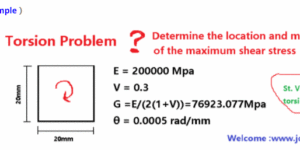
稳态热传导的控制方程与经典扭转理论的控制方程具有相似性。我们可以通过比拟,在通用有限元软件中利用稳态热传导分析的功能进行扭转问题的分析。本文结合Abaqus软件,通过一个实例说明这个比拟的具体过程。(The steady heat conduction problem and the classic torsion theory have analogy in their control partial differential equations. We can conduct a torsional analysis making use of the steady analysis fuction in general finite element program. This post gives an example on how to do torsion analysis as thermal analogy with Abaqus.)

Torsion analysis by thermal analogy with ANSYS (ANSYS热比拟扭转应力分析)

稳态热传导的控制方程与经典扭转理论的控制方程具有相似性。我们可以通过比拟,在通用有限元软件中利用稳态热传导分析的功能进行扭转问题的分析。本文结合ANSYS软件,通过一个实例说明这个比拟的具体过程。(The steady heat conduction problem and the classic torsion theory have analogy in their control partial differential equations. We can conduct a torsional analysis making use of the steady analysis …

Analysis of a Euler–Bernoulli beam with ANSYS [ANSYS 欧拉-伯努利梁分析]

欧拉伯-努利梁理论(Euler–Bernoulli beam)又称为工程梁理论(Engineering beam theory)或者经典梁理论(Classical beam theory)。欧拉梁不考虑剪切变形,与铁木辛柯梁(Timoshenko beam)相对。前面一篇博文《Analysis of a Euler–Bernoulli beam with Abaqus [Abaqus欧拉-伯努利梁分析]》复习了Abaqus中利用欧拉梁单元B23和B33单元进行悬臂梁的模拟,本文接着看看在 ANSYS APDL 中如何利用欧拉梁单元进行同样的分析。

Analysis of a Euler–Bernoulli beam with Abaqus [Abaqus欧拉-伯努利梁分析]

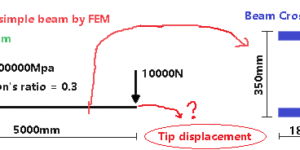
复习有限元知识,利用 Abaqus 进行欧拉-伯努利梁单元的分析。欧拉伯-努利梁理论(Euler–Bernoulli beam)又称为工程梁理论(Engineering beam theory)或者经典梁理论(Classical beam theory)。欧拉梁不考虑剪切变形,与铁木辛柯梁(Timoshenko beam)相对。Abaqus中的B23和B33单元为欧拉梁单元。 算例(Example) 有限元模拟(FEM Analysis) 采用Abaqus进行分析,单元B23。基本步骤如下: (1)设置工作路径并创建数据库(Set Work Directory and Create Model Database) (2)创建部件(Create Part) 由于分析问题为2D,模型空间选为 2D Planar;类型为 Deformable;基本特性为 Wrie。(As the problem is …

[Abaqus] Plate with Hole Stress Analysis [带孔平板应力分析]

利用ABAQUS进行弹性圆孔薄板的应力分析,复习弹性力学知识。 例子(Example) 如图所示为一带圆孔的平面薄板,圆孔的直径相对板的尺寸较小,板受两侧均匀平面拉力作用。根据弹性力学理论,圆孔的A点和B点存在应力集中,当板接近无限大时,A点应力的绝对值约为施加的水平应力绝对值的3倍,B点应力的绝对值约为施加的水平应力的绝对值。以下采用ABAQUS对该问题进行分析。 有限元模拟 (FEM Analysis) 算例中的平面板厚度较薄,且为平面受力,可简化为平面应力问题,由于板两个方向具有对称性,因此可以等效为图右的1/4模型的分析。 采用ABAQUS进行分析,单元采用最简单的常应力应变三角形单元(Constant Strain Triangle)。基本步骤如下: (1)创建部件(Create Part) 模型空间选为 2D Planar, 类型为 Deformable,基本特性为 Shell,绘制如下部件轮廓。 (2)定义材料 (Define Material) 定义弹性材料,输入弹性模量和泊松比 (3)定义截面 (Define Section) 定义截面,属性为固体和各向同性,并指定厚度。 (4)划分部件网格 (Mesh Part) 给网格布种,这里按边布种,并指定相应的偏心参数,使靠近圆孔附近的网格更密。指定单元属性为三角形,单元阶次为Linear,相应的单元名字为CPS3,对应为三角形平面应力单元,划分网格: …